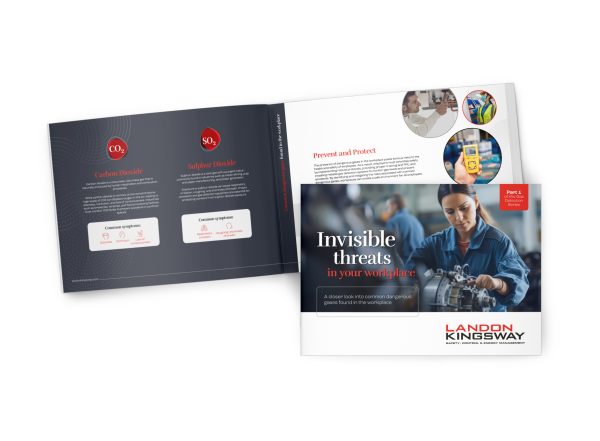
Gas detection systems: Invisible threats in your workplace
In this article…
Understanding the gases you can’t see and the systems that keep you safe
Some workplace risks are obvious: heat, noise, machinery, and moving vehicles. Others sit quietly in the air, often undetected until they become dangerous. Hazardous gases remain one of the most overlooked threats in industrial and commercial environments because they’re invisible, which makes workplace gas detection systems essential.
This is why UK facilities rely on integrated detection systems, and why Landon Kingsway has spent decades engineering solutions that identify invisible risks long before they have the chance to escalate.
Different gases behave differently, and each environment has its own vulnerabilities. Below, we break down the most common workplace gases, the risks they pose, and the real-life scenarios where detection becomes essential.
For more details, you can also download our guide:
Carbon monoxide is colourless, odourless, and extremely dangerous. It binds to haemoglobin far more readily than oxygen, meaning exposure can cause headaches, dizziness, loss of coordination and, at worst, fatality.
It can form anywhere combustion takes place, such as boilers, generators, furnaces, plant rooms, and forklift operations. You’ll find it in boiler rooms with poorly maintained burners, in generator backup systems in enclosed spaces, and in workshops using petrol-powered tools. Even a small concentration in a poorly ventilated space can quickly incapacitate staff.
Real-life example
In a boiler house with ageing ventilation, CO levels can rise during peak heating demand. Workers may feel mildly unwell without realising they’re experiencing early CO poisoning. A fixed detector triggers an alarm long before symptoms appear, prompting ventilation checks and preventing a serious incident. Reliable gas detection would include a fixed CO detector that activates ventilation and shuts down the unit before staff enter the room, keeping everyone safe.
Fixed CO monitoring, automatic ventilation response, and regular combustion equipment servicing are key measures for protecting people and infrastructure.
Hydrogen Sulphide (H₂S)
The one that steals your sense of smell
Hydrogen sulphide is infamous for its “rotten egg” smell. It’s toxic, fast-acting, and unmistakable, until concentrations rise and your sense of smell shuts down entirely. Left unchecked, H₂S can cause respiratory damage, loss of consciousness, and be lethal even with short exposure.
Common risk areas include wastewater treatment sites, biogas and anaerobic digestion plants, oil and gas environments, and pumping stations.
Real-life example
At a wastewater site, routine pump maintenance often involves confined space entry. Portable detectors can alert the team if a pocket of H₂S is released from stagnant sludge. Additional solutions include area monitoring near pits, enclosed tanks, or sludge handling systems.
Methane (CH₄)
The explosive one
Methane behaves differently from the toxic gases above. It doesn’t poison; it displaces oxygen. Where methane accumulates, ignition risk increases dramatically. It’s common in landfill and biogas operations, mining and tunnelling, gas-fired boiler houses, and agricultural slurry pits.
Real-life example
Despite the quality of construction, buildings can develop hairline cracks. This becomes a serious risk in a biogas storage dome. If methane escapes into an adjacent plant room, it risks ignition from electrical systems. A CH₄ sensor detects the rising concentration and shuts down electrical systems to prevent ignition.
Other protective measures include good ventilation, automatic shutdown interlocks, and CH₄ gas detection systems.
Ammonia (NH₃)
The aggressive irritant
Ammonia is common in refrigeration, food manufacturing, and fertiliser storage. While widely used, incorrect handling can cause burns, respiratory irritation, and serious injury. Risks typically arise in cold stores, refrigerated warehouses, industrial chillers, plant rooms, and agricultural facilities.
Real-life example
Valves degrade over time and must be monitored. If a valve seal in a refrigeration compressor begins to fail and it isn’t detected quickly, NH₃ can concentrate, forming visible vapour and creating both safety and operational risks. NH₃ detectors positioned at low and high levels, proper ventilation, rapid alarm escalation, and sensors integrated into refrigeration controls can detect rising concentrations before they become hazardous.
Chlorine (Cl₂)
Highly reactive, used in water and chemical treatment
Chlorine gas is common in facilities using disinfectants or chemical processes, including water treatment plants, chemical dosing rooms, laboratories, and manufacturing sites.
Real-life example
Fermentation is an anaerobic process. Microbes consume oxygen and release CO₂. If a flue becomes blocked in a brewery fermentation room, CO₂ can accumulate overnight. Fixed detectors, ventilation interlocks, and alarm beacons are effective workplace gas detection solutions that prevent staff from unknowingly entering an oxygen-deficient space.
Carbon Dioxide (CO₂)
Everywhere, and dangerous at high concentrations
CO₂ builds silently, especially in confined areas where production, processing, or fermentation takes place. It’s commonly found in breweries, beverage processing plants, food production sites, enclosed plant rooms, and dry ice storage areas.
Real-life example
Fermentation is an anaerobic process. Microbes consume oxygen and release CO₂. If a flue becomes blocked in a brewery fermentation room, CO₂ can accumulate overnight. Fixed detectors, ventilation interlocks, and alarm beacons are effective workplace gas detection solutions that prevent staff from unknowingly entering an oxygen-deficient space.
Sulphur Dioxide (SO₂)
A by-product of combustion and industrial processes
SO₂ is corrosive and highly irritating to the respiratory system. It’s commonly found in metal refining plants, pulp and paper facilities, power generation sites, and fuel combustion systems.
Real-life example
A burner in a boiler house may run rich due to a faulty air damper, increasing SO₂ emissions. Sensors integrated with extraction and burner maintenance schedules can alarm early, allowing maintenance teams to reset the system and prevent exposure.
Invisible doesn’t mean unpredictable
Dangerous gases don’t appear without cause; they emerge when systems age, components fail, equipment overheats, or processes change. That’s why reliable workplace gas detection systems must be built into your infrastructure, not added as an afterthought.
With the right sensors, placement, and integrated alarms, your site can respond before a hazard becomes dangerous.
Trust Landon Kingsway for complete gas detection systems and fire protection
With over 60 years of engineering expertise, Landon Kingsway supports commercial and industrial environments with reliable gas detection, fire isolation, and system integration.
We provide:
Products built for reliability, compliance, and long-term safety
Fixed and portable gas detection solutions
Fire and gas system design support
Specialist equipment for boiler houses, plant rooms, and hazardous industrial environments.
Book your free site survey
Our site surveys are full safety assessments. Our experts review plant layout, equipment, ventilation, and risk areas to ensure the correct protection is in place.
Call 0121 327 7881 or fill in the contact form below.
It is time to protect your people. It is time to protect your infrastructure. When safety systems need certainty, you need LK.
Follow us on LinkedIn to stay informed on our latest news and to learn more about mission-critical fire safety.
FAQs
Does Landon Kingsway offer gas detection system design and technical support?
Yes. We provide technical guidance to help you specify the correct sensors, layout, alarm levels, and integration points for your site. For full consultancy or installation services, we work with trusted specialist partners.
Can gas detectors integrate with existing equipment and control systems?
Yes. Our gas detectors and control interfaces can be integrated with: – BMS systems – Fire alarm panels – Ventilation and extraction controls – Automatic shutdown logic
This ensures that gas alerts trigger the right responses across your entire site.
How do I know which gases my site needs to monitor?
This depends on your processes, equipment, and environment.
As a guide: CO / CO₂ → combustion, boilers, generators CH₄ → gas-fired equipment, biogas facilities NH₃ → refrigeration and cold stores H₂S → wastewater and biogas handling Cl₂ → water treatment and chemical dosing
A site survey will confirm the correct detectors, alarm points, and sensor types.
How often should gas detection systems be tested or calibrated?
Most detectors require functional testing every 6–12 months and calibration annually, depending on the gas type and environment. LK provides maintenance guidance to keep your system compliant and reliable long-term.
What industries rely on LK gas detection systems?
We support a wide range of sectors, including: – Energy and utilities – Data centres and generator installations – Food and beverage production – Wastewater and biogas plants – Manufacturing and processing – Chemical handling sites
Anywhere hazardous gases may accumulate, LK systems provide critical monitoring.
How do I arrange a site survey?
Simply contact our team on 0121 327 7881 or via landonkingsway.com. A survey identifies the correct sensors, positions, alarm levels, and control logic to ensure complete protection.